

ShunyaMind
ShunyaMind

The Real Problems
Students Face

Not laziness. Not attitude. Not lack of effort. Just friction — invisible, internal, and measurable.

Students struggle long before the chapter begins. Parents notice the behaviour. Teachers see the inconsistency. Institutions feel the unpredictability.


  • 18 years of NEET/JEE Expertise
  • Rooted In Cognitive Science
  • Backed by Results
Student facing learning friction

The Internal Layers Behind Learning Difficulty

What no one sees is the internal friction that breaks learning from the inside.

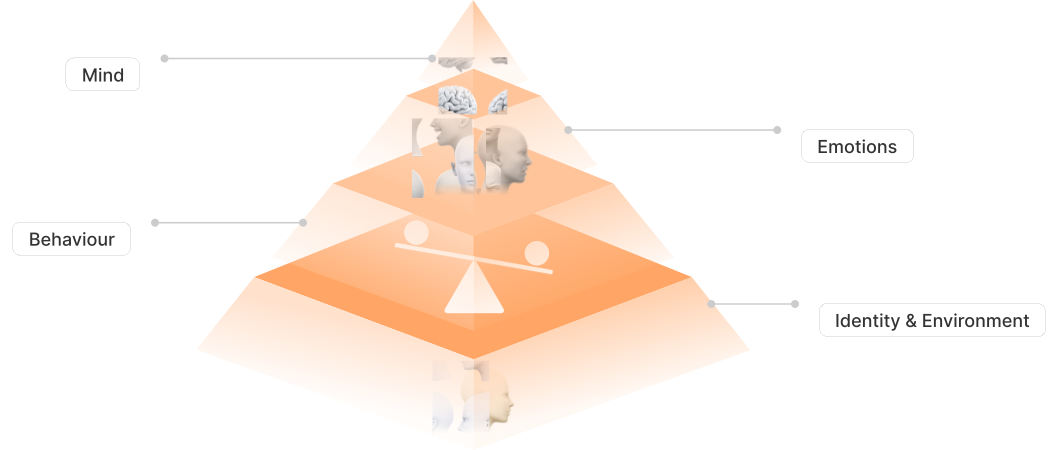
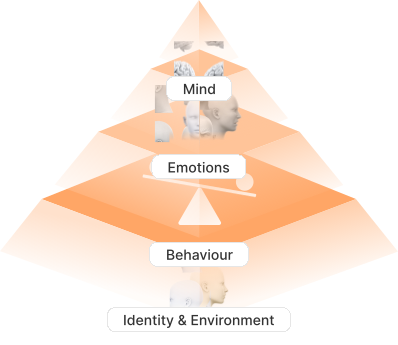
These struggles look different on the surface, but they all come from 4 layers within the learner.

Internal layers pyramidInternal layers pyramid - Mind, Emotions, Behaviour, Identity & Environment

This page shows those layers — clearly, simply, and without blame.

Core Categories of Learning Breakdown

A four-layer view of cognitive, emotional, behavioural, and relational friction.

Mind

When Cognition Breaks
"Why can't my mind just do what I want?"

These are not personality issues. These are bandwidth issues.

  • Focus collapses even with effort → working memory overloaded
  • Memory slips quickly → weak encoding
  • Understands in class, forgets at home → guided vs independent bandwidth
  • Mental fatigue hits early → cognitive load > capacity
  • Zoning out while reading → unstable attention loops
  • Blank-outs in exams → stress shuts recall
  • Can’t solve even after understanding → understanding ≠ integration

What this means for:

  • Students:I try but my mind won't stay.
  • Parents:They seem distracted all the time.
  • Teachers:Same topic, different day — no carryover.
  • Institutions:Results don't match potential.

This is Cognitive Friction — the silent breaker of learning.

Emotions

When Pressure Overrides Clarity

"Why does studying feel heavy inside?"

Students aren't weak. They're overloaded.

  • Fear before studying → emotional load attached to learning
  • Panic during tests → nervous system in threat mode
  • Anxiety with difficult chapters → memory of past failures
  • Irritation while sitting to study → emotional friction activating
  • Tiny mistakes feel huge → identity pressure
  • Crying before exams → emotional overload

What this means for:

  • Students:I don't know why I feel so heavy.
  • Parents:They get so anxious about exams.
  • Teachers:Emotions seem to block their output.
  • Institutions:Dropouts often cite stress.

This is Emotional Friction — the unseen pressure.

Behaviour

When Rhythm Fails

"Why do I behave opposite to what I want?"

Behaviour is not discipline. It is a broken rhythm.

  • Inconsistency despite motivation → motivation emotional, consistency cognitive
  • Delaying tasks → avoiding friction-heavy starts
  • Long warm-up time → bandwidth settling
  • Distracted without phone → internal escape from friction
  • Timetables breaking in 2–3 days → wrong rhythm, not wrong plan
  • Losing rhythm after one bad day → weak recovery loop
  • Studying well at night → circadian–cognitive mismatch

What this means for:

  • Students:I want to but I can't stick to it.
  • Parents:They're so inconsistent.
  • Teachers:Attendance and effort vary a lot.
  • Institutions:Engagement is unpredictable.

This is Behavioural Friction — broken rhythm.

Relations

When Context Adds Friction

"Why does my environment make it harder?"

Context isn't neutral. It either supports or blocks learning.

  • Fear of asking doubts → protecting the “capable student”
  • Constant comparison → external identity loops
  • “I’m not smart enough” → belief friction
  • Pressure killing confidence → expectations as threat
  • Remembering scolding more than chapter → emotional memory dominance
  • Hiding struggles → protecting image
  • Studying for others → meaning friction

What this means for:

  • Students:I feel judged, not supported.
  • Parents:We don't know how to help.
  • Teachers:Class dynamics affect outcomes.
  • Institutions:One size doesn't fit all.

This is Relational Friction — context that blocks.

The Truth Most PeopleMiss

Students don’t struggle because of lack of effort. They struggle because their internal learning conditions break long before they reach the chapter.

Shunya Mind identifies these conditions:

  • Maps Them.
  • Stabilises them.
  • And restores the learner beneath the pressure.

This page is not the solution. It is the mirror — showing what actually breaks inside the learner.

The truth most people miss - learning conditions

Ready to begin the
Learning Friction
Reduction journey?

Alpha Learner Activation Protocol™ is accessed after Learning Friction Assessment.

Get your Personalised 7-Domain Friction Map in 3 minutes.

Take the Free Learning Friction Check

Talk to a Cognition Mentor

who Understands your Challenges.

Background Pattern

Let's Rebuild How Students Learn

Book a 20-min Discovery Call or take the Free Friction Check. Your information stays fully confidential, and you’ll hear from us within 24 hours. (Institutions only.)

Contact Information

Contact:
+91 - 7300091470
Email:
institutions@shunyamind.com
Office Address:
R8, Royal Park, Deoli Arab Road, Near
Raipura Chouraha, Udyogpuri, Kota,
Rajasthan - 324004
Shunya Mind Icon

No spam. No sales pitch. Just a focused conversation.